
How? Accelerate Your Depreciation. Your Tax Savings Could Start Day One.
With 100% bonus depreciation recently signed into law, every dollar reclassified to short-life assets through a cost segregation study can be deducted in full starting the year your property is placed in service, or at any appropriate time thereafter. CostSeg Advocates delivers engineering-backed, IRS audit-ready studies so you can claim AND reinvest your savings with confidence.
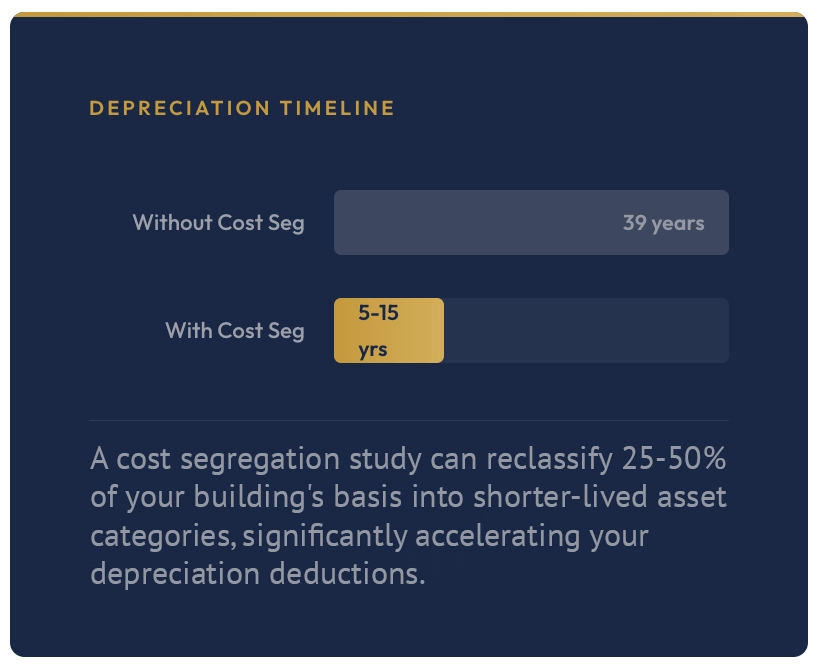
Cost segregation is a tax strategy that reclassifies certain components of your investment property into shorter depreciation timelines. Instead of depreciating your entire income-producing building over 27.5 years (residential) or 39 years (commercial); a cost segregation study identifies and values assets like flooring, specialty lighting, plumbing fixtures, and landscaping that can be depreciated over 5, 7, or 15 years.
The result? Larger deductions in the early years of ownership, reduced taxable income, and more cash in your pocket to reinvest. Think of it as an interest-free loan from the IRS: you defer taxes now, deploy that capital however you choose, and the tax liability doesn’t come due until you sell*.
* Speak to your tax professional about strategies to potentially delay depreciation recapture, and it’s tax liability, further; such as a 1031 exchange
The One Big Beautiful Bill Act (OBBBA), signed into law on July 4, 2025, permanently restored 100% first-year bonus depreciation for qualifying assets placed in service after January 19, 2025. Before this legislation, bonus depreciation was phasing down, dropping to just 40% in 2025 and heading to zero by 2027.
Now, every dollar reclassified through a cost segregation study can be written off immediately, in the year the property is placed in service. Whether you just acquired a property, completed a renovation, or have owned a building for several years, the window to maximize your deductions has never been wider.
Based on $500K–$700K reclassified to short-life assets at a 37% marginal rate. Actual results vary by property type and individual tax situation.
When you pay for improvements to a property you lease, those costs may be classified as leasehold improvements (or QIP, “qualified improvement property,” under current tax law). QIP is defined as interior improvements made by the taxpayer to non-residential real property after the building is first placed in service. This includes items like drywall, interior doors, ceilings, electrical systems, plumbing, and HVAC.
These are exactly the kinds of renovations a lessee typically makes, and they now qualify for an immediate 100% deduction in the year placed in service.
Every study is prepared by experienced construction engineers using industry-leading cost estimation technology. No shortcuts, no templates.
Our reports meet every IRS quality study requirement. If you're ever audited, we provide full remote support at no additional cost.
We provide a free benefit estimate showing your projected savings and study cost before you commit to anything.
Most studies completed within 4 to 6 weeks. We coordinate directly with your CPA for seamless integration into your tax return.
Multifamily, office, retail, industrial, medical, hospitality, self-storage, single-family rentals, and more. From $100K to $100M or more in basis.
Decades of construction engineering and tax expertise. Thousands of completed cost seg projects nationwide.
From first conversation to tax savings, we handle the heavy lifting.
We run the numbers on your property and show you the projected savings before you commit.
The IRS requires on-site verification for most properties. We handle this entirely. For
smaller properties ($500K or less in basis), we can often complete the analysis remotely.
Our construction engineering experts handle the cost estimating with precision and defensibility.
You receive a detailed, IRS-compliant report. We coordinate with your CPA to capture every deduction on your return.
Think of cost segregation as borrowing from the government at 0% interest, while avoiding the NPV erosion of your future depreciation savings.
You receive accelerated deductions upfront, deploy that capital into your next deal, pay down debt, or fund other ventures. The tax liability is deferred until you sell.* In the meantime, you’re earning returns on money that would have otherwise gone to the government.
For long-term holders, that’s years or decades of compounding.
** Speak to your tax professional about strategies to potentially delay depreciation recapture, and it’s tax liability, further; such as a 1031 exchange
Where else can you borrow at 0% with no payments?
A common misconception is that cost segregation can only be done in the first year of ownership. That’s not true. Even if you purchased your property years ago, you can capture all the accelerated depreciation you originally missed through a “catch-up” adjustment (Form 3115, Change in Accounting Method).
Here’s how it works:
In many cases, this actually increases the total value of the CostSeg study, since you’re recovering multiple years of missed deductions in a single tax year. And given the OBBBA’s permanent 100% bonus depreciation going forward, this is one of the most powerful tax planning tools available to commercial property owners right now.
Recover years of missed accelerated deductions in a single tax year, regardless of when you purchased your property, and without amending a single return.
There has been no indication of increase in audit probability for tax returns that include one of our engineering-backed studies. Cost segregation is a legal, transparent tax strategy. If you are audited, CostSeg Advocates provides full audit support at no additional cost.
Not at all. You can still benefit through a catch-up adjustment that captures all the accelerated depreciation you missed, potentially making the study even more valuable. And you do not need to amend any prior returns.
Not necessarily. In fact, a defensible cost segregation study requires engineering expertise (construction cost estimating) that goes beyond what a CPA alone can typically provide. That said, we work closely with our clients’ CPAs to ensure our CostSeg studies provide everything necessary to develop the most effective depreciation-related tax strategies possible.
Any income-producing property: apartments, offices, retail, industrial, medical, hospitality, self-storage, single-family rentals, short-term rentals, and more. Your primary residence does not qualify, but if you rent out part of your home or own a rental condo, that portion may be eligible.
The best way to find out is to request a free benefit estimate. We’ll show you the projected savings alongside the study cost so you can evaluate the ROI before committing.
Take your tax strategy to the next level. Request a free, no-obligation benefit estimate and find out how much accelerated depreciation your property could unlock.
Know your potential savings before you spend a dime.
A few things stand out looking across the full 40-year arc of depreciation policy:
Bonus depreciation didn’t exist until 2002. It was first enacted as an economic stimulus at 30% following 9/11. Before that, MACRS was the only game in town and everything depreciated on schedule, with no acceleration at all.
It has been consistently used as a stimulus lever. Every spike corresponds to an economic crisis or policy push: post-9/11 (2002), the Great Recession (2008-2011), and the TCJA pro-growth overhaul (2017). Before TCJA, Congress enacted laws offering businesses bonus depreciation for 13 of the prior 16 years. It was never treated as permanent; always a temporary tool to pull forward investment.
The 2010 100% window was the first preview. The Tax Relief, Unemployment Insurance Reauthorization, and Job Creation Act of 2010 temporarily allowed 100% bonus depreciation for property placed in service between September 8, 2010 and December 31, 2011. It lasted just 16 months before dropping back to 50%.
The TCJA era (2017-2022) was the golden window. Five full years of 100% bonus, available on both new and used property; the longest sustained full-expensing period in history.
The OBBBA is genuinely historic. The One Big Beautiful Bill Act permanently restores 100% bonus depreciation for most eligible property placed in service after January 19, 2025. This is the first time in the 23-year history of bonus depreciation that it has been made permanent rather than enacted as a temporary measure; a meaningful structural shift in U.S. tax policy.
To qualify for 100% bonus depreciation under the OBBBA, two timing conditions must be met: the property must be both acquired and placed in service after January 19, 2025. If you entered into a written binding contract before January 20, 2025, even if the work was completed later, the old phasedown rates apply (i.e., 80% in 2023, 60% in 2024, 40% in 2025 prior to January 20).
Lease term matters for accounting purposes. Under U.S. GAAP (ASC 842), leasehold improvements are depreciated over the shorter of their useful life or the remaining lease term (including reasonably certain renewal periods). Tax treatment under MACRS, however, uses the fixed 15-year period regardless of lease term.
Landlord reimbursements. If your landlord reimburses you for some or all of the renovation costs (tenant improvement allowances), that portion generally reduces your depreciable basis. You can only depreciate what you actually paid.
Improvements vs. repairs. Only capital improvements (not ordinary repairs and maintenance) are depreciated. Repairs can typically be deducted in full in the year incurred.
Who owns the improvement matters. If the lease requires improvements to revert to the landlord at lease end, that doesn’t disqualify your depreciation deduction. You can still depreciate the costs over the applicable period.
Section 179. You may also elect to expense leasehold improvements under Section 179, subject to the annual dollar limit (adjusted annually) and taxable income limitations.
Yes, you are also entitled to depreciate major renovation costs to reduce your federal tax (as well as certain states’ tax) liabilities as a lessee. The key variables are the type of improvement, when it was placed in service, and whether any landlord reimbursements reduce your basis.
For your specific situation, we recommend consulting a tax professional, as the interaction between lease terms, bonus depreciation elections, and Section 179 can significantly affect your optimal strategy.
On a hypothetical $1 million commercial building placed in service January 2019, a cost segregation study might identify roughly $350,000 in 5/7/15-year property. By 2026 (year 7), that property would already be fully or substantially depreciated under its normal schedule. The catch-up deduction would represent the difference between what you should have taken and what you actually took, potentially a very large lump-sum deduction in the current year.
Watch the recapture clock. The flip side consideration is that all the 5- and 7-year property you reclassify becomes subject to Section 1245 recapture at ordinary income rates when you sell, not the preferential 25% unrecaptured Section 1250 rate. If a sale is on the near-term horizon, model the recapture cost before pulling the trigger.